Winter hikes in Japan get a smaller crowd and a stranger, sharper version of the country. Frost builds into monsters on the fir trees of Yamagata. The Sea of Okhotsk freezes into a walkable field off the coast of Hokkaido. Mountain villages that rattle with tour buses in October go quiet enough to hear snow falling. This is not the easy season, and it should not be mistaken for one, but for hikers willing to work around shorter days and real cold, hiking in Japan between December and March delivers a landscape that summer visitors never see.
The country's winter trail network splits cleanly into two registers. In the north, Hokkaido and the Tohoku mountains around Zao and Hakkoda carry serious snow load from December through March, the kind that demands snowshoes, crampons, and often a guide. Further south, low-elevation routes near Tokyo and along the Kii Peninsula's Kumano Kodo stay largely snow-free, offering crisp, clear-sky walking without technical gear. The best winter hikes in Japan span both registers, and a well-planned trip can move between them: a few days of hut-to-hut snowshoeing in the Japan Alps, followed by a soak in an onsen town where the only ice is in the glass beside it.
None of this happens by accident. Winter closes roads, shuts down mountain huts, and strips out the infrastructure that makes summer trekking in Japan comparatively simple. Kamikochi, the gateway to the Northern Japan Alps, shuts its bus service and hotels completely from mid-November to mid-April, leaving the valley to snowshoers willing to walk in on their own legs. Understanding which regions stay open, which trails demand a guide, and which ones reward a solo hiker with nothing more than good boots is the difference between a trip that works and one that turns back at the trailhead.
This guide covers the terrain that makes winter hiking in Japan so different from any other season, the mountain hut etiquette that governs the trail, the specific windows when snow monsters form and sea ice arrives, eight trails worth building a trip around from Hokkaido to Kansai, and the food, lodging, and logistics needed to plan a winter hiking trip in Japan without guessing.
Explore our amazing hiking tours in japan now!
Japan's winter climate splits along a line that runs roughly down the spine of Honshu, and understanding that split explains almost everything about where and how to hike between December and March.
The Sea of Japan side of the country, facing the Asian continent, takes the brunt of the season. Cold, dry air masses cross the sea, pick up moisture, and dump it as some of the heaviest snowfall recorded anywhere on the planet, particularly across Niigata, Yamagata, and the western slopes of the Japan Alps. Hokkaido, the northernmost of Japan's main islands, sits inside this same weather system and adds its own extremes: the Daisetsuzan mountain range, an eroded volcanic massif at the island's center, holds Asahidake, Hokkaido's highest peak at 2,291 m (7,516 ft), where snow can arrive as early as September. The Pacific side, including Tokyo, Nikko, and much of the Kii Peninsula, sits in the rain shadow of these same mountains and stays comparatively dry, bright, and cold rather than buried.
That contrast is what makes hiking in Japan during winter so varied. The Japan Alps, straddling both weather systems, hold three parallel ranges, the Northern, Central, and Southern Alps, with peaks above 3,000 m (9,843 ft) that see genuine alpine winter conditions. Kamikochi, at 1,500 m (4,921 ft) in the Northern Alps, records temperatures below minus 20°C (minus 4°F) on clear winter nights, cold enough that even the fast-moving Azusa River freezes at its edges into ice formations photographers travel for. Further north, Hokkaido's Shiretoko Peninsula, a UNESCO World Heritage forest of Japanese oak and pine, sits at the point where drift ice, ryuhyo in Japanese, drifts down from the Amur River delta in Russia and packs against the coast, turning a stretch of ocean into solid ground for a few weeks each year.
Wildlife adapts to this split just as visibly. Steller's sea eagles follow the drift ice south to Shiretoko, gathering in numbers that draw birdwatchers from well beyond Japan. Japanese macaques, the country's famous snow monkeys, dig through powder for food in the high valleys of Nagano, and Japanese serows, a goat-antelope found only in Japan, move through the old-growth forest of Shiga Kogen largely undisturbed once the ski crowds thin out above the resort boundary. None of these animals require a special detour. They are simply part of what a hiker passes through on the way to the trail.
Japan's relationship with deep snow has its own name and its own literature. Yukiguni, snow country, refers to the band of heavily snowbound regions along the Sea of Japan coast, and it entered the national imagination largely through Yasunari Kawabata's 1948 novel of the same title, set in a hot spring town buried under exactly this kind of winter. The phrase still carries weight in Niigata, Yamagata, and Nagano today, describing not just a climate but a way of living built around six months of snow.
That way of living produced practical culture long before it produced literature. Villages across Tohoku and the Japan Alps developed steep-roofed farmhouses, gassho-zukuri among them, designed specifically to shed heavy snow loads rather than collapse under them, with the historic villages of Shirakawa-go and Gokayama earning UNESCO World Heritage status for architecture shaped entirely by this problem. Communities isolated by snowfall for months at a time built strong traditions of communal labor, shared food stores, and, in many mountain areas, onsen culture that treated hot spring bathing as a genuine survival tool against the cold rather than a spa indulgence.
Religion and mountain worship run through this same winter landscape. Shugendo, a syncretic practice blending mountain asceticism with Buddhist and Shinto elements, treats certain peaks, including sections of the Kii Peninsula's Kumano Kodo pilgrimage route, as sacred ground where winter walking becomes a form of devotion rather than recreation. The three Kumano shrines, Hongu Taisha, Hayatama Taisha, and Nachi Taisha, have drawn pilgrims along these paths for more than a thousand years, and a shorter winter walk between two of them still carries that same historical weight, even for hikers with no religious intent.
Zao Onsen's snow monsters, juhyo, sit at a stranger crossing point between natural phenomenon and cultural icon. The frost formations, built when supercooled fog freezes directly onto fir branches in repeated layers, have no ancient folklore attached to them; they became a national attraction only in the twentieth century once ropeways made the Zao summit accessible in winter. They are now one of the most photographed winter sights in the country, proof that Japan's winter culture keeps adding new chapters to an old story about a nation that never stopped adapting to its snow.
Anyone who has hiked the Alps or the Rockies in summer will recognize the general idea of a mountain hut. Japan's version, the yamagoya, runs on its own set of rules, and understanding them before a winter trip prevents an awkward first night on the trail.
Most yamagoya operate seasonally, opening from roughly July through September or October and closing completely once snow makes supply runs and staffing impossible. This matters enormously for winter hikers: the huts that support summer treks through the Japan Alps are, with a handful of exceptions near ski resorts or research stations, simply not there in December. Winter hikers plan around fixed lodges in gateway towns, guided hut-to-hut programs that maintain limited winter service, or full self-sufficiency with tents and stoves rated for extreme cold.
Where huts do operate, the etiquette is consistent nationwide. Boots come off at the entrance and stay off, replaced by hut slippers for indoor movement. Futons are typically shared in open dormitory rooms rather than private bunks, and lights-out runs early, often by 8 or 9 p.m., since most hikers are moving again well before dawn. Meals, when included, run on a fixed schedule rather than an a la carte one, and a hiker who misses the serving window generally misses the meal.
Trail etiquette carries its own winter-specific layer. Climbing registration, known as tozan todoke, is expected or legally required at trailheads across much of the Japan Alps and Hokkaido's mountain parks during winter, filed at a police box, ranger station, or drop box at the trailhead itself. It exists purely for search and rescue, giving authorities a starting point if a hiker fails to check out, and skipping it on a winter route is one of the more common and avoidable mistakes visiting hikers make.
Dive into our curated Japan hiking adventures today!
Winter hiking in Japan runs from December through March, but the window that matters most shifts by region and by what a hiker actually wants to see.
Snow arrives early in Hokkaido and the higher Japan Alps, often by late November, but accumulation is still building through December. This is a reasonable window for lower-elevation snowshoe routes near Nikko or Nagano, where snowpack is present but manageable, and for the start of Hokkaido's drift ice season along the Sea of Okhotsk coast, which typically begins arriving in mid to late January. Days are at their shortest here, with sunset well before 5 p.m. across most of the country, and New Year's week brings a spike in domestic travel and lodging prices nationwide.
###Deep Winter, Late January to February
This is peak season for the best winter hikes in Japan that depend on maximum snow and cold. Zao's snow monsters reach their fullest, densest form in February, when average temperatures at the summit run minus 10 to minus 15°C (14 to 5°F). Drift ice along the Okhotsk coast is typically at its thickest and most extensive during this same window, and Kamikochi's snowshoe routes see their coldest, driest, and often clearest conditions, though nighttime temperatures below minus 20°C (minus 4°F) are common and demand serious gear.
###Late Winter, March
Snow depth starts easing in March across most of the country, though high-elevation routes in the Japan Alps and central Hokkaido remain fully winter conditions well into the month. Zao's snow monsters begin thinning and softening by March, a noticeably less dramatic version of the February formations. This is a workable transition month for hikers who want winter scenery without quite the same depth of cold, though avalanche risk on steeper alpine terrain can actually increase as the snowpack begins to shift.
###What Is Not Recommended
Deep-winter ascents of unmarked backcountry peaks in the Japan Alps or Hokkaido's interior are not a starting point for visiting hikers without local guiding and full winter mountaineering experience. Avalanche terrain, whiteout conditions, and rescue response times that stretch into hours rather than minutes make these routes a serious undertaking even for experienced climbers, and this guide's trail recommendations are chosen specifically to avoid that category.
The eight routes below cover the real range of what hiking in Japan looks like in winter, grouped by the two regions that define the season, Hokkaido and the Japan Alps, followed by the gentler, lower-elevation options in Tohoku, Kanto, and Kansai that round out a trip. Difficulty varies as much as the scenery does, from a guided crossing of sea ice to a boardwalk an hour from Tokyo.
###Hokkaido, Winter's Wildest Edge
Hokkaido carries the heaviest, driest snow in the country, and its two signature winter hikes show two different ways to meet it, one on the mountain and one on the ocean.
###Shiretoko Peninsula
Shiretoko is the one entry on this list that puts a hiker on the ocean itself. From late January through March, drift ice from the Amur River delta, more than 1,000 km (621 mi) away in Russia, packs against the Okhotsk coast near Utoro and Abashiri. It is the southernmost point on Earth where this kind of sea ice regularly forms, solid enough in places to walk across roped to a guide in a dry suit, an experience closer to a polar expedition than a standard day hike.
Inland, the same cold builds a different kind of trail. A UNESCO World Heritage forest of oak, pine, and Ezo spruce covers the Shiretoko Five Lakes area, and guided snowshoe treks push beyond the summer boardwalk into deeper forest, tracking Steller's sea eagles overhead and the occasional print of an Ezo brown bear, dormant but not far off, in the snow. A short drive away at Lake Kussharo, hikers can dig a private pool into the volcanically heated sand along the shoreline, a low-key reward after a cold day on the ice.
Quick Facts, Shiretoko Peninsula Total Distance: 4 to 6 km (2.5 to 3.7 mi) guided snowshoe forest loop Duration: Half day to full day Difficulty: Moderate to Challenging Best Season: Late January through March for drift ice Gateway Town: Utoro or Abashiri Highlights: Ryuhyo drift ice walk, Shiretoko Five Lakes, Steller's sea eagles, primeval forest
###Daisetsuzan and Asahidake
Daisetsuzan National Park holds Hokkaido's entire high-mountain winter world in one place. Japanese hikers call the range Kamuimintara, the garden of the gods, a name first attached to its autumn colors that fits its winter silence just as well.
The Asahidake Ropeway climbs to Sugatami Station at roughly 1,600 m (5,249 ft), where sulfurous steam vents keep patches of ground bare even in the deepest snow, framed by frost-rimed pine and Asahidake's 2,291 m (7,516 ft) summit rising directly ahead. Reaching that summit in winter is a serious mountaineering objective for experienced, well-equipped climbers only, but the marked snowshoe loop around the station puts the same volcanic, otherworldly landscape within reach of any reasonably fit hiker, usually with far fewer people on it than the ropeway's autumn foliage season draws.
Quick Facts, Daisetsuzan and Asahidake Total Distance: 1.7 km (1.1 mi) Sugatami Station loop Duration: 1 to 2 hours for the loop, full day for the summit Difficulty: Easy for the station loop, Very Challenging for the summit High Point: Sugatami Station, 1,600 m (5,249 ft) Best Season: December through March, weather dependent Gateway Town: Asahikawa
###The Japan Alps, Silence Under Snow
The Japan Alps hold the country's highest peaks and, in winter, its quietest valleys. The two routes below sit at very different elevations, and both reward hikers willing to work around a closed season or thin oxygen.
###Kamikochi
Kamikochi in summer is one of the most visited valleys in the Northern Japan Alps, sometimes called the birthplace of Japanese mountaineering after Walter Weston, the British missionary credited with popularizing alpine climbing here in the 1890s. In winter, with the resort officially closed from mid-November to mid-April, it becomes one of the quietest places in the range, its monument to Weston usually buried to the shoulders in snow.
Guided snowshoe treks in from the Nakanoyu gate follow the frozen Azusa River past Taisho Pond, its half-submerged trees rimmed in ice and reflecting the Hotaka peaks on clear mornings, toward Kappa Bridge. Temperatures below minus 20°C (minus 4°F) are routine, the valley floor stays coated in dry powder rather than the packed snow of a ski resort, and this route is not a solo introduction to winter hiking.
Quick Facts, Kamikochi Total Distance: 7 km (4.3 mi) one way, Nakanoyu to Kappa Bridge Duration: Full day Difficulty: Challenging Best Season: January through March Safety Note: Guide strongly recommended, climbing registration required at Nakanoyu gate
###Shiga Kogen
Shiga Kogen sits inside Joshinetsukogen National Park at more than 2,000 m (6,562 ft), and its guided snowshoe routes reach old-growth forest of Japanese hemlock, larch, and white birch that summer hikers rarely see buried this deep. Japanese macaques and serows move through the same terrain, and the guided format opens sections of the park that heavy snowfall otherwise closes to independent hikers.
The area doubles as one of Japan's largest ski resorts, which makes it an easy add-on rather than a dedicated expedition. A morning snowshoe tour through silent forest pairs naturally with an afternoon on groomed runs, or with a short trip down the valley to Jigokudani Monkey Park, where wild snow monkeys famously soak in their own open-air hot spring through the coldest months.
Quick Facts, Shiga Kogen Total Distance: 5 to 6 km (3.1 to 3.7 mi) guided route, distance varies by conditions Duration: Approximately 3 hours Difficulty: Moderate High Point: Above 2,000 m (6,562 ft) Best Season: December through February, extending into spring Combined Well With: Nagano's ski resorts and the Jigokudani snow monkey park
###Zao Onsen, Yamagata
Zao is the single most photographed winter hike in Japan, and it earns that reputation honestly. Supercooled fog freezes onto the region's fir trees in repeated layers, building the juhyo, snow monsters, into shapes that look less like frost and more like sculpture. A ropeway from Zao Onsen village climbs through the formations to Jizo Sancho Station, and evening snowcat tours light the frozen trees for night viewing through early March.
Quick Facts, Zao Onsen Total Distance: 2 km (1.2 mi) summit viewing loop Duration: Half day, including the ropeway ride Difficulty: Easy High Point: Jizo Sancho Station, approximately 1,736 m (5,696 ft) Best Season: Mid-January through early March, peak in February Highlights: Juhyo snow monsters, night illumination tours, Zao Onsen hot spring village Kanto, Winter an Hour from Tokyo Not every winter hike in Japan requires a flight to Hokkaido or a guide into a closed valley. A ring of low mountains around Tokyo stays largely snow-free through the season, and the two routes below make a strong case for starting a trip close to the capital before heading further north.
###Mt Takao
Mt Takao is the most climbed mountain in Japan, and in winter that popularity works in a hiker's favor rather than against it: a cable car and chairlift both run to the halfway point, the main Trail 1 route is paved and well maintained the whole way, and snowfall at this elevation rarely amounts to more than a light dusting. Yakuoin, a Buddhist temple founded in 744, sits roughly two-thirds of the way up and gives the ascent a sense of occasion beyond just reaching a viewpoint.
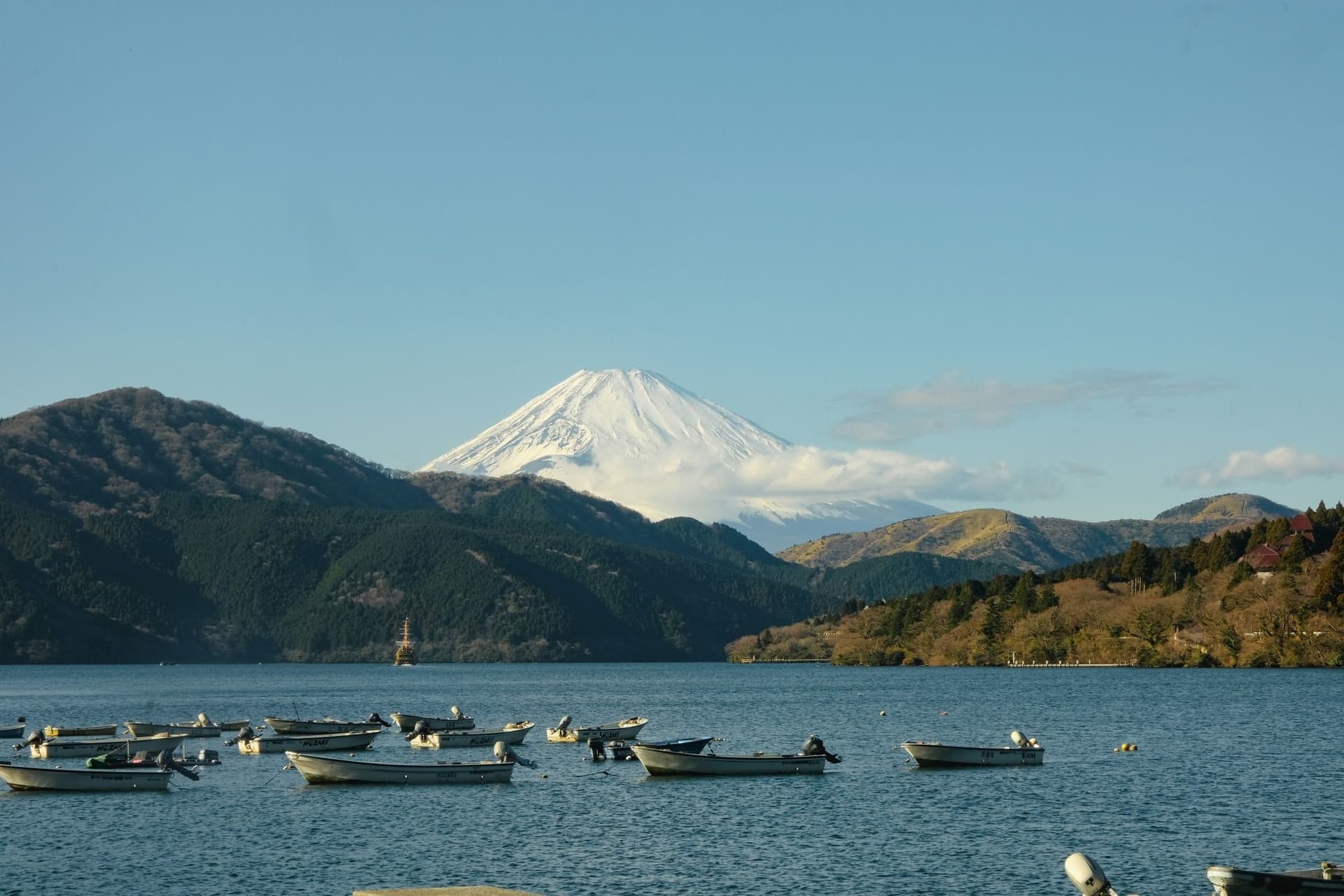
The reward at the 599 m (1,965 ft) summit is a clear-day view of Mt Fuji across the Kanto Plain, sharpest precisely in the cold, dry air of December and January. Hikers who want fewer crowds than the main trail draws can loop through the Minami-Takao Seven Summits route instead, a longer, hillier alternative that trades convenience for quiet.
Quick Facts, Mt Takao Total Distance: 3.8 km (2.4 mi) via Trail 1, up to 7 km (4.3 mi) on the Seven Summits loop Duration: 1.5 to 4 hours depending on route Difficulty: Easy, Moderate on the Seven Summits loop High Point: 599 m (1,965 ft) Best Season: Year-round, clearest Mt Fuji views December through February Gateway Town: Takaosanguchi Station, about 50 minutes from Shinjuku on the Keio Line
###Senjogahara, Nikko
Senjogahara is the more dramatic of the two Kanto entries and a natural next step once Mt Takao starts to feel too easy. A flat, well-defined boardwalk crosses a frozen marshland plateau inside Nikko National Park, framed by the peaks of Mount Nantai and the surrounding Nikko range, with snowshoes available for rent at the Sanbonmatsu tea house along the route.
The walk extends easily toward Odashirogahara, where a single white birch stands out against a stand of brown oaks, a favorite stop for photographers working the plateau in winter light. Few winter walks in Japan combine this much open sky with this little technical difficulty.
Quick Facts, Senjogahara Total Distance: Approximately 6 km (3.7 mi) loop Duration: Half day Difficulty: Easy Best Season: December through March Gateway Town: Nikko, via bus toward Yumoto Onsen Combined Well With: Chuzenji Onsen hot springs Kansai's Frozen Reward Kansai rarely comes up in a conversation about winter hiking in Japan, which is exactly what makes Mt Rokko worth a detour for anyone based in or passing through Osaka or Kyoto.
###Mt Rokko
Mt Rokko rises directly behind Kobe, close enough that a hiker can leave the city by train and be on the summit ridge within the hour. In the coldest stretches of January and February, seasonal waterfalls along the mountain's flanks freeze into thick columns of ice, a sight that draws a small but dedicated following of photographers and hikers willing to time their trip around a cold snap.
The route down the far side of the mountain toward Arima Onsen turns the hike into a full day out rather than a summit-and-return. Arima ranks among Japan's oldest hot spring towns, referenced in texts more than a thousand years old, and its two mineral-rich waters, an iron-tinted kinsen and a clear, carbonated ginsen, make the descent as much a reward as Mt Takao's summit view is further east.
Quick Facts, Mt Rokko Total Distance: Approximately 6 km (3.7 mi), summit to Arima Onsen Duration: Half day Difficulty: Moderate High Point: 931 m (3,054 ft) Best Season: December through February for frozen waterfalls Gateway Town: Kobe, with a direct route down to Arima Onsen
Get started with your Hiking adventure now!
Winter hiking in Japan comes with its own food season, built around dishes designed to put heat back into a body that has spent the day in subzero air.
Nabe, the country's broad category of hot pot, changes by region in exactly the way a winter hiking trip does. In Hokkaido, ishikari nabe simmers salmon, cabbage, and tofu in a miso broth that reflects the island's fishing industry, while Yamagata's imoni nabe, built around taro root, beef, and burdock, is traditionally cooked outdoors in autumn and winter gatherings large enough to need a dedicated festival. Further south, Nagano's oyaki, filled dumplings of buckwheat or wheat dough stuffed with vegetables, function as trail food and comfort food at once, sold at nearly every rest stop through the Japan Alps.
Ramen earns its reputation as Japan's winter staple honestly. Sapporo's miso ramen, rich and fatty enough to survive a Hokkaido winter, pairs a thick noodle with a broth built for cold, and a bowl after a day on the drift ice or in the Daisetsuzan snow is close to a ritual for guided groups working that region. Oden, a lighter broth simmered with fish cakes, daikon, and boiled eggs, turns up at convenience stores nationwide through winter, making it the easiest hot meal for a hiker moving between trailheads with no time for a sit-down restaurant.
The onsen ritual belongs on this list as much as any dish does. Soaking in a hot spring after a cold hike is not an optional indulgence in Japan's winter hiking culture, it is close to the expected close of the day, and towns like Zao Onsen, Yudanaka, and Nyuto Onsen in Akita built their entire identity around exactly this sequence of cold trail followed by hot water. Hot sake, kanzake, served warmed through winter months, and amazake, a sweet, low-alcohol rice drink sold at shrine stalls and rest huts, round out the season's specific drinking culture.
Resupply on the trail itself is rarely difficult near populated regions. Japan's convenience store network, conbini, operates in nearly every gateway town even through winter, stocking hot food, rice balls, and hot drinks around the clock. The exception is genuine backcountry travel in the Japan Alps or central Hokkaido, where the last conbini can be hours behind a hiker and carrying two to three days of food is the standard, sensible precaution.
Accommodation for winter hiking in Japan runs almost entirely through fixed lodging in valley towns rather than the mountain huts that support summer trekking, since most yamagoya close for the season, as covered earlier in this guide.
Ryokan, traditional Japanese inns, are the backbone of a winter hiking trip and often the entire reason to choose one gateway town over another. A typical night runs from roughly 8,000 to 25,000 JPY (55 to 170 USD) per person including two meals, with private onsen rooms and higher-end properties in towns like Zao Onsen or Nyuto Onsen pushing toward the top of that range. Minshuku, a simpler, family-run alternative to the ryokan, offer the same basic model, shared bathing, home-cooked meals, at a lower price point, typically 6,000 to 10,000 JPY (40 to 68 USD) per person.
Business hotels and capsule accommodation fill the gap in larger gateway cities such as Asahikawa, Matsumoto, and Yamagata, useful for hikers arriving late or needing a straightforward, no-frills base before a guided trek. Where guided winter programs operate, as in Shiretoko or Kamikochi, lodges affiliated with the guide service often handle both the trek and the accommodation as a single booking, which removes most of the planning burden for a first-time winter visitor.
Booking ahead matters more in winter than the shoulder seasons might suggest, not because trails are crowded but because ski resort towns near several of these hikes, Niseko and Hakuba among them, pull in enough international ski traffic to fill nearby lodging and push prices up through the January and February peak. New Year's week nationwide is its own separate booking crunch, driven by domestic travel rather than skiing, and is worth avoiding entirely for a first winter hiking trip.
Get started with your Hiking adventure now!
###Getting There
Tokyo's Narita and Haneda airports remain the primary international gateways, with the Shinkansen network extending winter hiking access efficiently from there. Yamagata is reachable by a direct Shinkansen from Tokyo in around two and a half hours, putting Zao within a half-day of arrival. Matsumoto, the gateway to the Japan Alps and Kamikochi's winter trailhead, sits roughly three hours from Tokyo by limited express train. Hokkaido requires a separate flight into New Chitose Airport near Sapporo, from which Asahikawa and the Shiretoko gateway towns are a further two to five hours by train, bus, or rental car.
###Navigation and Conditions
Yamap, a Japan-specific hiking app with offline GPS tracks, is the standard tool among both Japanese and visiting hikers for winter route planning, and it carries current trail condition reports that generic mapping apps miss entirely. For any route beyond the easy, well-marked category, such as Senjogahara or Mt Takao, a licensed local guide is worth the cost purely for the up-to-date knowledge of snow depth, avalanche advisories, and closures that no app fully replaces.
###Safety Considerations
Short winter daylight, with sunset before 5 p.m. across most of the country, is the most consistently underestimated factor in winter hiking in Japan, and any itinerary should build in a wide safety margin before dark. Avalanche risk is real and specific to certain slopes in the Japan Alps and Hokkaido's interior, and hikers on anything beyond the easy routes in this guide should check regional avalanche advisories before setting out. Climbing registration, tozan todoke, filed at trailhead police boxes or drop boxes, is expected practice across the Japan Alps and Hokkaido's mountain parks in winter and should never be skipped.
###Currency and Connectivity
Japan runs on the Japanese Yen (JPY), and while IC cards such as Suica and Pasmo cover most urban transport and convenience store purchases, small ryokan and minshuku in rural mountain towns frequently remain cash-only, making an ATM stop in a larger city before heading into the mountains a sensible habit. Mobile coverage is generally reliable in gateway towns but drops out on the more remote sections of routes like Kamikochi and Shiretoko, another reason a guide or a filed climbing registration matters.
###Is winter a good time to go hiking in Japan?
Yes, for the right routes. Winter rewards hikers with scenery that simply does not exist the rest of the year, from Zao's snow monsters to Shiretoko's drift ice, but it demands more planning than a spring or autumn trip. Sticking to the established routes in this guide and matching the trail to your experience level makes it a genuinely rewarding season rather than a risky one.
###Do I need snowshoes or crampons for winter hikes in Japan?
Most of the trails in this guide either provide snowshoe rental on site, as at Senjogahara, or include snowshoes as part of a guided package, as at Shiretoko and Kamikochi. Crampons or microspikes become necessary on icier, steeper terrain, particularly in the Japan Alps, and a guide will typically supply or advise on this gear rather than expect hikers to source it independently.
###Is Kamikochi open for hiking in winter?
The valley itself remains physically accessible, but Kamikochi's official season closes completely from November 16 to April 16, shutting hotels, shops, and the regular bus service. Winter access is entirely by guided snowshoe trek in from the Nakanoyu gate, and this is not a route to attempt without a guide on a first visit.
###Do I need a guide for winter hiking in Japan, or can I go independently?
Easy, well-marked routes such as Senjogahara and Mt Takao are entirely manageable independently with basic winter layers and, where needed, rental snowshoes. Anything involving drift ice, alpine terrain above 2,000 m (6,562 ft), or a closed-season valley like Kamikochi should be done with a licensed guide, both for safety and because several of these experiences, drift ice walking especially, are not accessible without one.
###Do I need a permit for winter mountain hiking in Japan?
No general permit system covers recreational hiking in Japan, but climbing registration, tozan todoke, is expected or required at many Japan Alps and Hokkaido trailheads during winter. It is a safety measure rather than a bureaucratic hurdle, filed at a trailhead police box or drop box in minutes.
###What is the best region for beginners doing winter hikes in Japan?
Mt Takao, close to Tokyo and served by a cable car and a paved main trail, is the most forgiving entry point in this guide. Nikko's Senjogahara and Shiga Kogen's guided routes are reasonable next steps for a beginner ready for higher elevation and deeper snow with professional support.
###When do the Zao snow monsters form?
The juhyo begin forming as temperatures drop through December, reach their fullest, most defined shapes in February, and start thinning and softening through March. February is the narrow window most photographs of the formations are taken in, and it is worth planning a Zao visit specifically around that month.
###What should I pack for winter hiking in Japan?
Layered clothing built around a moisture-wicking base, an insulating mid-layer, and a windproof, waterproof outer shell covers most conditions, supplemented by insulated gloves, a warm hat, and gaiters to keep snow out of boots. For alpine routes such as Kamikochi, that list extends to expedition-rated cold-weather layers, best confirmed with a local guide before departure.
###Can I combine winter hiking with skiing or onsen visits?
Yes, and it is one of the more natural itineraries in the country. Nagano's ski resorts sit close enough to Shiga Kogen's snowshoe routes to combine both in a single trip, and nearly every hiking region in this guide, from Zao to Mt Rokko, is built around an onsen town that makes the combination of trail and hot spring feel less like an add-on and more like the point.
###The Season Few Hikers See
Winter hiking in Japan rewards a hiker who wants a country stripped down to its coldest, quietest version, from a frozen sea ice field on Hokkaido's coast to a hot spring town built entirely around a mountain's snow. The Japan Alps and Hokkaido hold the deepest, most demanding version of that season, while routes near Tokyo, Nikko, and Kobe keep the door open for hikers who want the atmosphere without the technical commitment.
What sets this season apart is not just the scenery but the culture built to survive it: yamagoya etiquette, snow country literature, and an onsen tradition that turns a cold trail day into its own kind of reward. Explore our guided hiking journeys in Japan at Art of Active Travel.
Dive into our curated hiking adventures today!
Create a private trip or join a small-group departure.